'Hope and Fear Walk in Step' — Seneca on Releasing the Mind from Expectation and Anxiety
Seneca observed that hope and fear rise together because both depend on a future we cannot control. Discover the Stoic practice for loosening expectation and anxiety alike, and reclaiming a calm present.
Why Hope and Fear Always Arrive Together
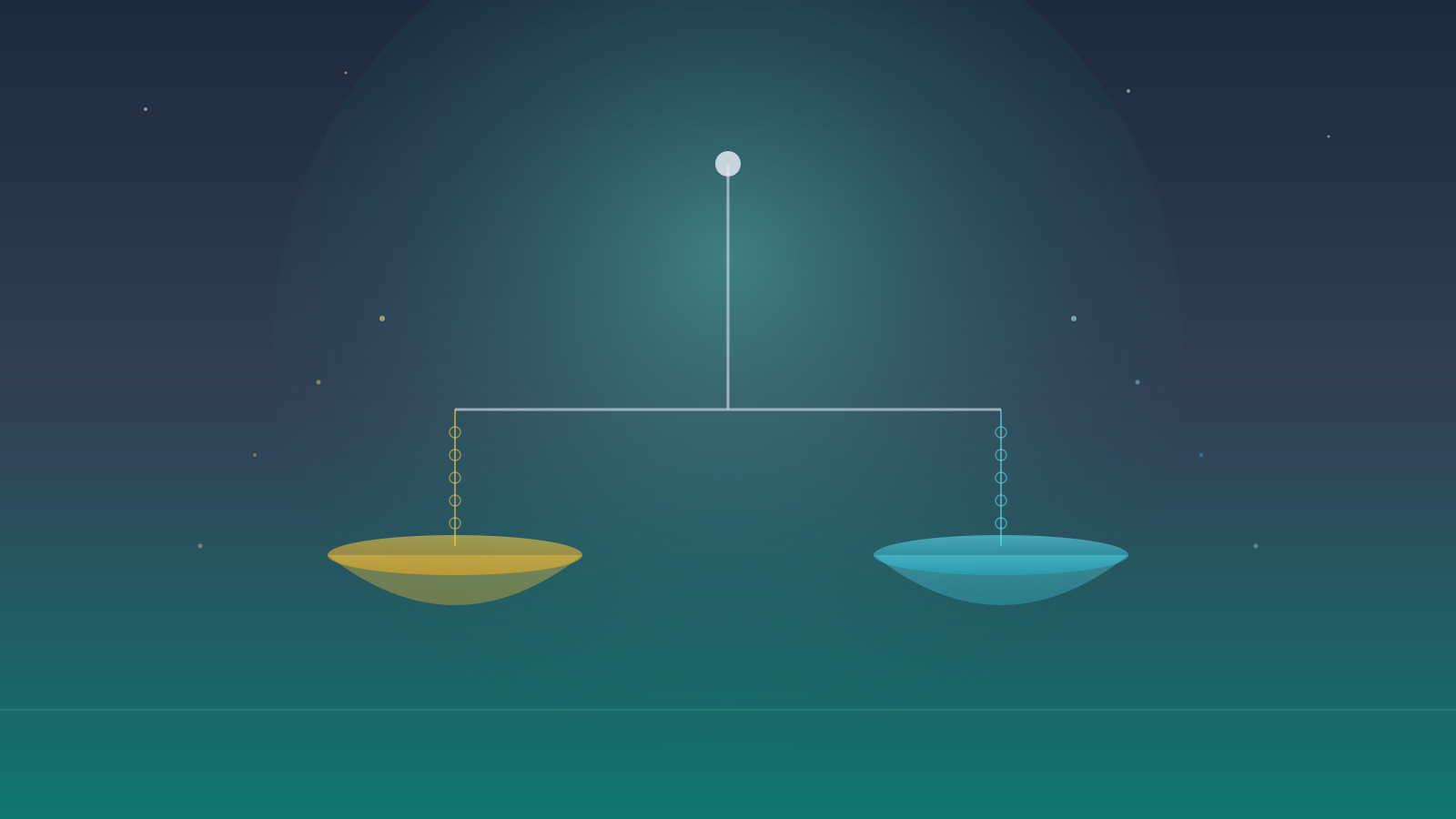
In Letter Five of his Letters to Lucilius, Seneca writes: "The same cause produces both hope and fear. They are signs of a mind in suspense, of a mind upset by looking forward to the future." Although hope and fear feel like opposites, structurally they are identical: both stretch the mind toward an event that has not yet happened.
Waiting for a promotion contains the hope "If it comes through, I will be happy" and the fear "If it does not, I will be crushed." Waiting for a medical result, the wish "Please let everything be normal" sways at the same height as the worry "What if it is not?" The taller hope grows, the taller fear grows beside it.
What the Stoics objected to was not hope or fear themselves, but the habit of handing our entire inner peace over to them. The future is never fully under our control. If today's mood depends on tomorrow's outcome, we condemn ourselves to a life perpetually tossed by external events.
How Modern Life Inflates Expectation Until It Exhausts Us
Modern culture is engineered to inflate hope. Social feeds parade ideal futures in front of us, and news cycles alternate between "the next big success" and "the next looming threat." Without noticing, we invest enormous emotion in stories that have not yet arrived, while paying less attention to what is actually in front of us.
Psychologists describe a phenomenon called anticipatory anxiety: the period of expecting an event often drains us more than the event itself. The moment a dental appointment is scheduled, part of us starts living next Tuesday. Likewise, an exciting trip can rob us of sleep the night before, even though the trip itself has not begun.
Hope and fear both forward our emotions into the future, borrowing against today's vitality. Like compound interest, the fatigue accumulates, and by the time the day actually arrives, our tank is half empty. This is the underlying mechanism of what many people now call "expectation fatigue."
Seneca's Prescription: Release from Expectation
How then did Seneca tell us to live? His prescription is not cold nihilism but warm-blooded realism.
First, he urged: "Do not live in the future; live now." Elsewhere he writes, "The greatest obstacle to living is expectancy, which depends on tomorrow and wastes today." Do today the preparation that today allows—but do not stake today's mood on results that have not yet arrived. Drawing this line is the key to keeping hope and fear from running wild together.
Second, he encouraged transforming demands into preferences. The harder we squeeze a "this must happen," the bigger the fall when it does not. Replace it with the softer "I would be glad if it happens, and I can accept it if not." This sits between Stoic preferred indifferents and full detachment, and it is one of the most practical emotional postures available.
Third, he taught the practice of premeditatio malorum: quietly imagining the worst in advance. This is not pessimism. By accepting the worst inwardly once, the shock is softened if it arrives, and gratitude deepens if it does not. It is training that narrows the swing between hope and fear from the inside.
Watching the Small Hopes and Fears in a Single Day
Beyond the big future-events, an ordinary day is built from a chain of small hopes and fears. Watching them reveals our personal patterns.
In the seconds before opening the morning email, the wish "Let there be good news" and the dread "Please nothing painful" go up together. Walking to a meeting, the prayer "Let me speak well" hides behind it the worry "What if I stumble?" Waiting for a child's test result in the evening, parental love sits next to the fear of one's own disappointment.
I notice the same thing in myself when I open my inbox in the morning. For a long time I assumed the small tightening in my chest was simply "responsibility." Watching more closely, I realised it was a quiet reflex of fear—the wish to protect myself from possible bad news. Since noticing, I exhale once before opening, and quietly tell myself, "Just opening. Nothing has happened yet." It is a tiny gesture, but the weight of the first ten minutes of my day has shifted.
Four Practices for Shrinking Hope and Fear
Here are four practices for translating Seneca's teaching into daily life.
The first is the question that gives the future a shape. When the mind has run ahead, ask: "How likely is what I am worrying about, really?" and "If it happens, what is one move I could make?" A future with a clear outline is far less frightening than a vague one.
The second is rephrasing wishes. When you catch yourself thinking "It must turn out this way," rewrite the sentence in your head: "I would be glad if it does, and I can meet it if it does not." Writing this on paper amplifies the effect.
The third is choosing one best use of today. To stop depending on future outcomes, name a single act you can complete today such that, by evening, you can honestly say, "Doing this was enough for today." Hope and fear point at the future, but the source of satisfaction sits firmly in the present.
The fourth is decoupling from results. Epictetus put it as: "Do your part, and leave outcomes to fortune." Two people can do identical work with completely different inner cost; the one who does not chain identity to results conserves vastly more energy. Focus attention on the process and treat outcomes as something to receive, not something to extract.
Not Killing Hope, but Refusing to Depend on It
A common misunderstanding deserves correction: the Stoics did not despise hope. Seneca and Marcus Aurelius hoped for a better world and worked toward it. What they warned against was depositing the entire weight of life's meaning into hope.
If your world collapses the moment a hope fails, that was not hope—it was dependence. If your character and today's good actions remain intact when hope fails, that is healthy hope. The first exhausts; the second sustains. The same word "hope" hides a vast difference between dependence and aspiration.
The same applies to fear. Fear that protects health or detects danger is essential information. But fear that rehearses the same unwritten event over and over until it eats into present joy is no longer intelligence; it is addiction. Seneca was trying to loosen exactly that chain of dependence and addiction.
A Small Experiment for Reclaiming Calm
To close, here is one small experiment. The next time you are waiting for a future result, take a piece of paper and write the matter at the top. Below it, write "the desired outcome" and "the unwanted outcome," and beside each, a single line about how you would continue to live if it happened.
Something quietly shifts. You realise that whichever result arrives, your life will continue. Hope and fear both shrink, and the emotion you had loaned to the future returns to the present. On some evenings the sky simply looks better than usual.
Seneca said, "Limit your wishes and you will limit your fears. Limit your fears and you will be free." You do not need to discard hope. Just loosen the chain a little, and give your heart back to the day in front of you. That small, repeated choice is the path to emotional freedom that Stoic philosophy has been quietly offering for two thousand years.
About the Author
Stoic Quotes Editorial TeamWe share the timeless wisdom of Stoic philosophy in a way that is easy to understand and applicable to modern life.
View author profile →Related Articles
'Only the Present Can Be Lost' — Marcus Aurelius on the True Nature of Time and Living Now
'Expectation of Tomorrow Is Life's Greatest Obstacle' — Seneca on Carving Purpose Into This Morning
'When the Mind Is Disturbed, First Be Silent — Silence Is the First Remedy' — Seneca on Calming Panic Through Silence
'Those Who Bear Hardship Together Lighten Each Other's Burden' — Seneca on the Bonds and Strength Gained Through Shared Struggle